Sunday, June 2, 2019

Did We Create Chief Eddie Gallagher?: Thoughts on Navy SEAL Worship


Navy SEAL Chief Petty Officer Edward Gallagher is accused of, in May 2017, stabbing an unarmed, wounded Iraqi teenager.  The boy, a suspected insurgent fighter, had been injured, and the SEAL medics were attempting to patch up his wounds when Gallagher allegedly stabbed him in the neck and in the side.   Shortly thereafter, Gallagher apparently held his impromptu reenlistment ceremony over the body.

Fellow SEALs reported also that Gallagher, in previous incidents, had sniped a girl walking down by the river and an older man carrying a water jug, and at other times, he had fired into civilian crowds.  Consequently, his comrades began secretly altering his sniper rifle to make it less accurate, and they would fire warning shots themselves to scare away civilians before Gallagher came along.

Gallagher, currently being held at the Navy Medical Center in San Diego, denies these allegations and awaits trial and/or perhaps a presidential pardon.  

To some Americans, Gallagher is a hero.  To others, he is a war criminal.  Still, others might view him as something in between: a tough guy who did what we sent him to do, for better or for worse.  How we view Gallagher depends, in part, on our politics.  That is, on how we view his line of work, on how we view his alleged victim—innocent, or righteous, or neither?—and on how we view the scene/country of the crime—member of axis of evil or occupied, oppressed people?  Potential Trump pardon aside, Gallagher remains innocent until proven guilty.
*

Whether he is found guilty or not (or is pardoned), I believe that we the American people are complicit in the crimes committed.  

I am not simply talking about our sending Gallagher and others “over there” for a combined eight overseas deployments and those deployments compounding into some PTSD that eventually caused him to snap and use a hunting knife to stab an Iraqi boy.  

It is possible that that was or is part of the equation.  PTSD is real, but by itself, PTSD is too clinical, too facile an explanation here.  I am talking about a deeper, more culturally-incubated, often latent causation.  I am talking about our worship of SEALs and, by extension, our worship of military “heroes,” whether deserved or not.  And, how that reflexive worship can feed the militarism and nationalism that makes such a stabbing possible in the first place.        
*

The first SEAL—short for “Sea, air, and land,” one of the navy’s special operations forces—I was introduced to was either Casey Ryback or LTJG Dale Hawkins, I can’t recall.  Both were hot-shot badasses, but neither was real, of course.  Hawkins was played by Charlie Sheen in the aptly titled Navy Seals (1990).  Ryback, i.e. Steven Seagal’s character in Under Siege (1992), was actually an ex-SEAL—a cook of all things—by the time I met him.  His earlier SEAL training, however, served him and the country well when he took the ship back from Tommy Lee Jones’s band of mercenary, terrorist hijackers.  

Neither was actually a good film by most standards—I find them hard to watch in my 30s—but both entertained twelve-year-old boys well back in the day.   

The first actual SEAL I met was at the US Naval Academy, during Summer Seminar 1999.   We rising high school seniors—and aspiring midshipmen-naval officers—sat in awe of the SEAL chief on the stage.  He regaled us with stories from his training, from his “hell week” for instance. He shared stories—presumably the unclassified ones—from conflicts he was involved in (“conflict” is what we called war in the 1990s).  He told us about leadership and about grit.  We saw that grit in his face and on his hands.  A great number of us wanted to be just like him.  I didn’t want to be exactly like him—I didn’t think I had either the courage, the prowess, or the mandibles to become a SEAL—but I stood in awe of him nonetheless.  We had met other officers and chiefs throughout the week, but this was a SEAL in front of us.

A couple years later, I met some other real SEALs, in closer quarters.  That time, I was a midshipman on “summer cruise” with the USS Albany, a fast-attack submarine.  SEALs had deployed with us on the sub off the coast of Spain, and they were conducting exercises, getting into a mini-submarine, and then going out some distance and doing things SEALs do.  Practice-do, I believe, not do-do, although I’m not sure. 
*

Navy SEALs loom large in the American public and psyche.  Actual SEALs, fictional SEALs, fictional SEALs based on actual SEALs, former SEALs, it doesn’t matter—we love and revere them.  Bradley Cooper/Chris Kyle in American Sniper.  John Krasinski/Jim Halpert/Jack Silva in 13 Hours.  Chris Pratt and company in Zero Dark Thirty.    

Former SEALs in government have a lot of street cred, too.  Sometimes more perceived cred than actual and sometimes more short-lived than long-.  Part-Teddy-Roosevelt-Rough-Rider, part-Casey-Ryback, part-Montana-white-settler-colonial-faux-cowboy, former SEAL Ryan Zinke rode a horse to his first day of work as Interior Secretary.  Then, he quickly dove headlong into corruption and scandal in his brief tenure and proceeded to open up federal lands for his fossil fuel friends. Then he resigned.  

(“...And the horse you rode in on.”)

Former SEAL Erik Prince built his mercenary Blackwater empire, comprising other former SEALs and special ops people.  Then, he avoided war crimes charges in Iraq, changed the name of the company and hid out in Dubai for some time.  Now, he has come back with a vengeance and arrogance in recent years—his sister Betsy DeVos meanwhile dismantling the Department of Education from within, very SEAL-like of her—and has pitched his new mercenary viceroy plan to ostensibly get the US out of Afghanistan.  He does this all with the gall of a non-war criminal—or war criminal if you prefer, as that is very in right now.  Bannon, Don Jr., and many other frustrated, white guys are enamored with Prince and what he represents.  As investigative reporter Matt Cole points out:

They love the myth of Erik Prince, the Navy Seal, of the former secret CIA agent…. This guy really has so much in common, aside from his military experience, so much in common with the president of the United States and I can see why someone like Don Jr. then, you know, they come from sort of a similar background in some ways of wealth and privilege, but this guy was willing to be a Navy SEAL and has done the dirty deeds and gotten his hands dirty.


Like Don Jr., notably and randomly, Tiger Woods also has a (reverse) celebrity-crush on the SEALs.  He has made VIP visits to SEAL training locations, shot their guns, run their obstacle course, and given talks.  Tiger’s vicarious flirtations with them are bewildering and yet, in the context of American SEAL/hero/celebrity worship, completely normal.  Apparently, he had dreamed of becoming a SEAL himself.  Like Don Jr. though, he too had to settle.

Even liberals have a weakness for SEALs.  Obama vowed to withdraw from Iraq but then to escalate in Afghanistan.  In the latter, we would have a new reliance on special forces.  Stanley McChrystal, not a SEAL but special operations regardless, was celebrity-general under Obama until his celebrity got him in trouble.  We know, too, William McRaven, Navy SEAL, celebrity-admiral who oversaw the Osama bin Laden raid.  SEALs and special ops mean a lighter military footprint.  Not so much “shock and awe” but smarter, quicker, stealthier, techier.  That combined with some drone strikes—the “gig war” alongside the “gig economy”—became our preferred liberal cocktail.  Meanwhile, that Iraq-to-Afghanistan pivot gave us liberals an out (or an in), to say, “Look, we’re not crazy anti-war people.  We’re sophisticated, tactical. We might be against the Iraq war, but we’re not against all war. We’re serious people….Full speed ahead on Afghanistan.”  SEALs helped give us that opportunity.  Politically, psychologically.

Finally, there are the fake SEAL stories.  Mr. Rogers, for one.  Urban legends that he used to be a Navy SEAL and had a bunch of tattoos (which is why he wore long sleeves all the time) are harmless enough and even a little funny.  But, it does beg the question, of peddlers of this urban legend, why a genuine cultural hero can’t just be the sweetest and loveliest man ever (which Fred Rogers was) but needs a violent past to make him more legit.  

The SEAL rumors were funny, too, for Tom Barna, who was a teacher and then administrator at my high school.  While less well known than Mr. Rogers, he was genuine and sweet too.
*

Why do we need SEALs?  There is the military geo-strategic question, and then there is the psychological question.

On the geo-strategic level, I guess I’m glad they exist.  I’m glad that Osama bin Laden is no longer around and that neither my schmuck friends nor I had to go in and get him.  Especially, in a hypothetical, actually defensive, history-started-yesterday-no-historical-context-needed, just-war scenario, I’m glad there are people braver than I am to do “what needs to be done.” 

History, though, didn’t begin yesterday, and most of our “engagements” overseas are not defensive.  Maybe that’s more on us than on the SEALs, but that is another blog post for another day.  Questioning these engagements does send us down that same clichéd path: you’re either a “traitor” or a “pussy” or both.  Colonel Nathan Jessup reminds both us and Lieutenant Coffey, should we dare to question the efficacy or morality of a particular engagement: "You want me on that wall. You need me on that wall.”  When SEALs are involved, that clichéd response is multiplied because SEALs are revered and worshipped even more than the regular soldier.  Just watch the coverage of Chief Gallagher on Fox and Friends--coverage that Trump then downloads as his marching orders (well, don’t actually watch Fox). 

More than the geo-strategic military angle however, here I am interested in why we need SEALs, culturally and psychologically speaking?  What do Casey Ryback and Ryan Zinke give us?Historian, Vietnam veteran, and gold-star father, Andrew Bacevich, in Breach of Trust, illustrates the unique relationship of the American public to the American military, especially in the last forty years.  Borrowing slightly from Occupy Wall Street’s lexicon, there is the “1 percent” at the top—the millionaires and billionaires, whose bank accounts we covet.  There is the 1 percent at the bottom “whose members get sent to fight seemingly endless wars.”  (While the bottom 1 percent economically does not completely match up with the 1 percent in the military, poor and working class people—often people of color—do disproportionately comprise the military.)  And then, there is the 98 percent in the muddied middle—we who will never actually attain top 1 percent status and who will never actually attain bottom 1 percent grit either.  We live dull, unsatisfying lives, or we convince ourselves that we live dull, unsatisfying lives and that some external adventure will satisfy.  Part of us envies the bottom 1 percent’s heroism and grit.  Most of us armchair warriors actually live quite complicated, nuanced, and messy—if not sexy—lives, but we nevertheless envy what appears to be a rawness and simplicity in the “heroes”’ decisions: black/white, shoot/no shoot, die/kill.

Among other incongruities, this worship-yet-distance helps create a warrior caste that is above reproach and perhaps even above the law.  In the case of SEALs: no, the majority are not Chief Gallagher or Erik Prince, but add to the extra special reverence SEALs receive the fact that the organization is deployed all over the world and has limited oversight, and there is greater ability and temptation to “go rogue."  

Bacevich’s hypothesis of the military-cult-worship is not specific to SEALs or special forces, but because they’re the “best of the best,” I believe his hypothesis is doubly true when it comes to them.  As for our role: “In a free society, some are guilty, but all are responsible” (Rabbi A.J. Heschel).

In a similar vein—channeling both Greek mythology and Freud—Chris Hedges describes the battle between Thanatos and Eros, i.e. the death drive and the life drive, in War Is a Force that Gives Us Meaning:

This love, like death, radiates outwards. It battles Thanatos at the very moment of death's sting. These two fundamental impulses crash like breakers into each other. . . . Love alone fuses happiness and meaning….We believe in the nobility and heroic self-sacrifice demanded by war, especially when we are blinded by the narcotic of war. We discover in the communal struggle, the shared sense of meaning and purpose, a cause. War fills our spiritual void. . . . This is a quality war shares with love, for we are, in love, also able to choose fealty and self-sacrifice over security. 

Thanatos and Eros battle each other within individuals, and they battle each other within civilizations.  At both levels, souls are at stake.  When war is unleashed, societies imagine they are thriving, but the narcotic of war is rotting all of its other (non-war) institutions.  This often takes place slowly.  Its effects can be latent.  Soldiers—and war reporters like Hedges and others close to war—appear to thrive, but the narcotic kills them literally and/or rots them spiritually.

Because war is a force that gives us meaning and the warriors are heroes that give us meaning, we venerate the SEALs.  The actual, fictional, and fake ones.  The good ones and the bad ones.  We revere them in the similar macho ways that we revere cowboys, Custer, Texas Rangers, Border Patrol, John Wayne, Clint Eastwood, Rambo, Andrew Jackson, celebrity chefs, and ice road truckers. 
*
What did we SWOs—surface warfare officers—think about SEALs?  To the degree that we thought about them at all, in one breath, we viewed them as uncouth—not too much better than those Marine jarheads.  We were the philosopher-warriors after all, drinking scotch on top of Hong Kong skyscrapers and smoking cigars on bridge wings in Tokyo Bay, discussing both Alfred Thayer Mahan and This American Life, our hands and consciences cleaner and our missiles sleeker.  But in another breath, we were also likely jealous of them, in the way that we were jealous of those “brown shoe” navy pilots.  Both groups cooler and more admired—from the outside and the inside of the navy—and more fictionalized/filmed than we were.

A colleague of mine recently told me he wished he had signed up for the military like I had—that he had put on the uniform like I had.  I told him not to worry about it—that he didn’t miss much--but, I get where he is coming from.  That was part of what drove me to sign up.  That is, when boyhood fascinations with the military faded, there was still that lingering (late adolescence) question: would I regret not signing up, every time I saw someone else in uniform?  And while I did serve, part of me wishes that my time was grittier, more hard-core.  Something like the SEALs.  I would have more street credit, from myself and from others.  That’s not rational, but it’s true. 
*

Because I'm not in the end a pacifist, I imagine there are times when we would need SEALs (or any other special force, or armed force for that matter).  In a sane country with a sane military budget, with a moral foreign policy and an emotionally mature and sexually secure populace, we would use them sparingly and justly.  When we would have to use them, we would neither shun them nor gush over them when they returned.  We would re-enter them intentionally and not worship them reflexively. We would honor those who deserved it, which by the way would not be everyone.  (If everyone who puts on a uniform is a “hero,” hero loses its meaning.) 

And if this war or fighting was necessary, we would understand that it was a serious, somber undertaking.  It could not be reduced to pre-football game flyovers and seventh-inning-stretch “God Bless Americas.”  The SEALs and soldiers who would have to do this fighting—we would recognize their moral injury and help reintegrate them.  Saint Augustine’s just war was predicated on this.  And even if the cause were just, which is a bigger and bigger “if” these days, there would still be moral injury.  There would still be internal and ritual work required required to put Thanatos back in balance with Eros.  Because it would be—because it is—such a serious, somber undertaking, we wouldn't treat it lightly.  We wouldn’t cheaply worship nor creepily envy the soldiers, but we would deeply pity them.  And we non-soldiers—we, too, would be morally injured.  Not as greatly, but injured still and in need of healing.  We would need to put respective Thanatos back in balance with Eros.   

During this process, we would not be so frivolous.  Our frivolity—our cheap hero-worship—has fed Thanatos, at the expense of Eros.  In our frivolity, we plant the poison seeds for the next war, the next war criminal, and the next gangster-president to rise.   
*

Whether or not Chief Gallagher himself is found guilty, whether or not that boy needed to die, Thanatos nevertheless reigned supreme in that stabbing.  And Thanatos certainly reigned and celebrated when, after a chance to catch their breath, the SEALs conducted the reenlistment ceremony over the dead body.
*

According to The New York Times reporting around Chief Gallagher, there are two general subsets in the SEALs or at least in that crew of SEALs:

There’s this subculture that has grown up within the SEALs. Some people call them the Salts. Other people call them the Pirates. But we’re talking about these roguish war fighters, the guys who’ve really been there and done the stuff. And those people are really prized in this culture. You know, it is a culture of war fighters. And they celebrate toughness, and they celebrate killing in ways that I think a lot of us would find kind of shocking. And to a certain extent, they care less about the rules than they do about getting things done. And they will cover for each other when necessary. And these documents prove that that pirate culture is there. But they also show us this whole subculture we never knew about, people who disprove the Pirates, that don’t agree with what they’re doing, that don’t think they should be able to get away with things, that think they should be reported. And those people, one of the SEALs described them to me as the Boy Scouts.   

If a force like the SEALs must exist, and if the above description is true, it would behoove us to lift up the boy scouts and not the pirates.  Definitely not pardon the pirates, at least.

Yes, how we view Gallagher depends, in part, on our politics, as I stated at the beginning.  But it also depends on how we view ourselves.  Who will we be: boy scouts or pirates?  The choice is as important for us pretenders as it for the SEALs.  As Kurt Vonnegut warns in Mother Night, “We are what we pretend to be, so we must be careful about what we pretend to be.”

Saturday, March 16, 2019

Becoming White (Saint Patrick's Day 2019)


In grade school, I recall green-iced cupcakes and parent-coordinated parties for Saint Patrick’s Day.  I think we were allowed to wear green that day—a departure from our Saint Jude uniforms—and I most likely partook.  One Saint Patrick’s Day, I recall eating shepherd’s pie at Nana’s. I didn’t know anything about Irish or Irish-American heritage, but this was something we did, sort of.

In high school, I remember becoming a little more aware—aware that being Irish meant not being Italian, at least.  Unless one was both, I guess.  I recall Mr. Turner ripping on Mr. Parisi’s Italian-ness and by extension ripping on Justin Philemeno, Chris Curci, and the other Italian last names in our class.  This was during instructional time, but we didn’t mind taking these frequent tangents from our world history textbook.  In counterposition to Philemeno, etc., I became cognizant of fellow classmates with Irish last names: Bonner, Clark, McAllister, O’Connor, Toole, O’Toole, Fagan, Egan, and Dougherty.  The last one, Dougherty, was the most popular name in our graduating class. There were eight of them.  I recall, too, the occasional Irish pride bumper sticker on cars in the parking lot: “IRL,” the US and Irish flags intertwined, or even “26 + 6=1,” referring to the 26 counties of the Republic of Ireland and the six counties of Northern Ireland making up one future united country.  

In college, I dressed up in green on Saint Patrick’s Day and, as a new fan of “Fighting Irish” football, on six Saturdays every fall.  I did not partake in the underage binge drinking, but on Saint Patrick’s Day and those six Saturdays, plenty of classmates paraded around green and drunk.  Even though we were French-founded, Notre Dame does have some legitimate Irish connections and Irish-American roots. There are robust academic and co-curricular partnerships between Notre Dame and institutions in the Republic.  The controversial Gerry Adams, no less, gave a talk on campus my senior year.  But more important than Irish politics, I met Haneys, Hugheses, Murrays, Murphys, Lynches, O’Briens, Reillys, and others.  They were from Catholic prep schools similar to mine, in suburbs similar to mine, but instead of outside Philadelphia, they were from outside Chicago, New York, Boston, Cleveland, Pittsburgh, and Cincinnati.  With a couple of the tamer ones, i.e. ones less likely to drink on a Wednesday afternoon (when Saint Patrick’s Day fell on a Wednesday), we ate soda bread sent by one guy’s mom and listened to “The Wild Rover.”  After a couple more Irish folk classics, we then made a generational and cultural jump to U2’s Rattle and Hum, and in particular, to Bono’s mid-“Bloody Sunday” political rant.

In the navy, I made up for the aforesaid lack of binge drinking, both on Saint Patrick’s Day and other days.  I drank green beer and listened to the Chieftans and Dropkick Murphys at Cassidy’s Irish Pub, while wearing my green short shorts.

But aside from a ten-day backpacking trip to its rugged west coast in 2010, I have no real connection to Ireland.  No one that I know of has done the ancestry.com research to explore our Fitzgibbons side.  And so, I am admittedly a “plastic paddy.”  We plastic paddies abound in the Philadelphia suburbs and at Notre Dame and places in between.  While it can be obnoxious, that plasticity and the March 17 kitsch that goes along with it, for the most part, is harmless.

*

Along the way, sometime between the first generations’ arrival and today, the Irish in American became “white.”  There was a time when we weren't white, as the early-comers suffered great poverty and discrimination.  Through the generations however, they fought, made alliances—some holier than others—and worked hard to make it out of the lowest social and economic rungs.  Like German Americans around the same time and later southern and eastern European groups, they assimilated relatively well over time and became part of mainstream American culture and society.  It didn’t hurt that they had the right pigmentation and language, mostly.  To make it was to become “white.”  This assimilation and acceptance process was simultaneous with, more broadly, Catholics' becoming mainstream in the United States.   

Even though we are no longer underdogs, among our semi-diaspora today are members who like to play up the underdog side of the Irish, who like to play up their heritage.  I’ve been guilty of this myself.

Being mainstream, being privileged and suburban, being white, having “made it” in the U.S., is a nice perk.  That is a truism.  But at the same time, it can be boring, or lame. It can be boring because it lacks a good underdog, edgy story, and everyone wants to think they’re part of a good story.  And so, with a loose sense of British-Irish relations and of Irish-American history—and sometimes a couple drinks in—many of us indulge in a little victimhood-working-class-days nostalgia.  Many of the old Irish folk songs point that way.  Perhaps that’s how the “26 + 6=1” bumper sticker can be found on an oversized luxury SUV in the parking lot of LaSalle College High School, no bastion of radicalism (btw, yearly tuition in 2019: $24,000). Similar victimhood-indulgence was present when we listened to the “Bloody Sunday” rant on repeat.  

Rattle and Hum, in my opinion, was U2 at its rawest peak.  But by the 2000s, when we were watching that DVD, U2 had already become “white” as well.  And preferring philanthropy to fair taxation I suppose, Bono stopped paying taxes in Ireland.

*

Becoming white has brought great privilege.  But, becoming white has also brought new moral hazards.  Once victims of poverty, racism and nativism, and empire, we now have become practitioners of these great sins.   

On wealth and poverty.  Irish-Americans (as much one can define us as an ethnic group now, with both generational distance from the homeland and mixing with other ethnicities) are one of the wealthiest and best educated ethnic groups in the United States.  This upward social mobility and assimilation in our history can be cause for celebration.  By themselves, they do not warrant repentance.  No group wants to remain on the outside, and no sane, sober person should want to remain destitute or persecuted.  But, as Eileen Markey wrote this time last year for The New Republic:


The Irish in America are tenacious in their cultural identification, claiming an Irish identity a century or more after our forbearers stepped off the boat. We keep our poetry and our grudges, but in the long years of assimilation we seem to have shed what was once a hallmark of Irish identity: a solidarity with the oppressed….

As the Irish left the subway tunnels, mills, and nursery wards for the middle and upper middle class, maybe we held hard to the wrong things. Step dancing classes and children’s names with complicated Irish spelling, but not the old neighborhoods’ practice of shared advancement. Donations to the Irish Studies Departments at prestigious colleges, but not commitment to the on-ramps that did us so much good.  

In the mid-1800s, many Irish fled to the United States because of the potato famine, as is well known.  What is less well known is that while 400,000 Irish starved to death, British landlords, with the blessings of the British government and the Anglican Church, continued to export 17 million pounds sterling worth of grain, cattle, pigs, flour, eggs, and poultry from Ireland to Britain and other markets.  Thus, in addition to biology and geography in the potato famine saga, it was a strange, cruel, early-global-capitalist logic that caused so many more to perish.  Now, we have been fully assimilated into an even more sophisticated, yet equally strange and cruel global-capitalist logic.  We sit near its helm.

Another symbol of our collective forgetting is the Molly Maguires.  Again, Eileen Markey:  


The Sons of Molly Maguire, a clandestine organization of Irish and Irish American labor radicals in coal country Pennsylvania in the 1870s, took their inspiration—and possibly some members—from a group of the same name in Ireland that set fires, killed livestock, and assassinated the gentry who had starved them off their land when the potato crop failed.... Likewise, there was no lack of income in America’s coal country. The Molly Maguires directed their rage at the mine owners growing fat off their bent backs and blackening lungs. Their actions helped pave the way for unions and collective bargaining.

I am not for sabotage and assassination, but at the least I am for this knowing this history.  In my college dorm that Saint Patrick’s Day eating soda bread, we listened to “The Molly Maguires,” by the Dubliners, but we didn’t know what it was about.  We didn’t care to ask either.

On race.  Daniel O’Connell, in 1854, wrote from Ireland:


Over the broad Atlantic I pour forth my voice, saying, come out of such a land, you Irishmen; or, if you remain, and dare countenance the system of slavery that is supported there, we will recognize you as Irishmen no longer....  Passage to the United States seems to produce the same effect upon the exile of Erin as the eating of the forbidden fruit did upon Adam and Eve. In the morning, they were pure, loving, and innocent; in the evening, guilty.

Noel Ignatiev, author of How the Irish Became White, and other scholars argue that in many circumstances the Irish in America gained white status by resisting abolition and taking up the mantle of anti-black racism.  Furthermore, “While Irish-American repealers maintained a pride and love for their homeland, they acted unabashedly American in the way they dealt with the slavery controversy,” Angela Murphy writes in American Slavery, Irish Freedom: Abolition, Immigrant Citizenship, and the Transatlantic Movement for Irish Repeal.

Throughout the past 150 years or so, the heavily Irish-American composition of police departments has colored our relationship to the historically over-policed African-American community.  Today, with the more blue-collar Irish Americans who become police, an intra-class cultural war plays out between the Fraternal Order of Police and Black Lives Matter.  Meanwhile, we middle- and upper-class Irish Americans, who would not think of joining the police force ourselves, nevertheless find more in common and therefore have more sympathy with Officers McMellon, Carroll, and Murphy, for instance, than we do with Amadou Diallo .  We read “anti-police brutality” as “anti-police,” and ask obtusely, “Don’t all lives matter?”  

On immigration and nativism: Irish Americans now as the gatekeepers is one of the greatest ironies.  The first anti-immigrant law in our history, the Alien Act of 1798, targeted the Irish.  For much of the next century, the Irish landing in America—before there was much of an established way to “come here legally” (“We came here legally!  Why can’t you?”)—were treated with nativist contempt and as second-class citizens.

By the 1930s, still mostly working-class, we felt we had made enough of ourselves to bully the newer groups that had arrived.  Irish antisemitism, often fueled by the Church’s bad theology and bad faith, was rife in Boston, Philadelphia, and places in between.

And now, we arrive at today’s scene.  The Trump team, both official and unofficial, both past and present, is littered with Irish Americans: Bannon, Flynn, Conway, Kelly, Mulvaney, Hannity, O’Reilly, Ryan, McConnell, Kavanaugh, to name a few.  Mike Pence boasts of his Irish roots (his grandfather named “Cawley”).  About fifty percent of the 33 million Irish Americans voted for Trump.   Not that supporting another candidate, in that or any other election, grants full absolution—we all have “dirty hands” (R. Neihbeur) in this “filthy rotten system” (D. Day)—but Trump’s message was and is so clearly racist, nativist, and nationalist.  Those who voted for him are complicit in his anti-immigrant agenda.

The Hannitys-Ryans-McConnells of this world hold up the image of the Molly Maguire miners (or the police officer)—gritty, working class, in theory socially mobile—at the same time that they do the bidding of the mine owners.  Many working-class whites fall for this millionaire-populist ruse.  And too many Irish Americans in the middle—in their management offices with shirt and tie, neither Paul Ryans nor Molly Maguires, and perhaps feeling insecure about their own lack of grit—take the bait.  Nationalism sells.  

This nationalism leads and feeds, finally, into empire.  In becoming assimilated, while taking up residence in the halls of power, we have become the practitioners of war and empire.  This has been an interesting historical twist.  Having suffered at the hands of the British empire for hundreds of years before crossing the Atlantic, we now hold the imperial offices, both civilian and military, in the empire that has replaced the British.  Under some administrations, this U.S. empire has been slightly more benevolent.  Under other administrations, including the current one, it doesn’t even pretend to be.  Under both types, Irish Americans of recent generations have been in lock-step.

As the trump-ets sound for war in Venezuela or Iran, as drones reign over and rain on Somalia, as weapons sales flow to regimes of all stripes, where do we fall in?  To the degree that we care or even know, most of us fall in line.

Which Irish-American spirits will we invoke, if given the choice?  The Robert McNamaras in our country or the Daniel Berrigans?        

(Aside: In a potentially terrible twist of imperial fate, Britain returns to its pastime of redrawing borders even after its own empire has dissipated.  The Brexiteer clowns who voted to “take their country back” and leave the European Union did not think—or did not care—about what effect that might have on the border between the Republic of Ireland and Northern Ireland.  A border and a region that has seen its fair share of troubles.)   


            *

Wealth accumulation; racism and nativism; empire and war.  Irish-American practice of these sins is not exceptional in the United States.  Other European immigrant groups who have assimilated are guilty of the same.  And in the long view of world history, the United States is not exceptional in these pursuits.  We are just the latest and greatest.  It nevertheless warrants lament, repentance, and conversion.

Could we learn from other groups?  While no people is a monolith, we can learn from those groups in our nation’s history who have been the leaven, the mustard seeds—who have called us to be our best selves.  For one, African Americans steadfastly remain a "blues people."  They have converted their trauma into prophetic witness.  Jewish Americans, informed by their own historical trauma and prophetic tradition, famously became allies in the civil rights movement, and they remain courageously committed to social justice broadly today.  

If we must dig into our own heritage—and even exaggerate it, for those of us who are the plastic version—let us then hold up the Irish and Irish-American stories, prophets, poets, mystics, musicians, and activists who have bent the arc toward justice.  Yes, we have become white, and we need to be honest about that.  There are too many of us to even be special anymore.  But we could become “green” again, and not just on Saint Patrick’s Day.  If that involves standing with today’s victims and instead of standing by triumphantly, then so be it if it’s a little kitschy, indulgent, or overplayed.  


            *

In Ireland, the backdoor Brexit border question looms.  Tension from the Troubles lies just below the surface still in many corners in the north.  The economy eventually rebounded after the false real-estate promises of the “Celtic Tiger” had gone bust and wreaked havoc, but now chasing that gold once again, at the other end of the rainbow, could bring peril.  The Catholic Church’s unquestioned power and abuse has cast dark shadows over the island.   

And yet, Ireland is a sign of hope, at least for me.  It became the first country to divest from fossil fuels, for example.  The Irish lower house passed a bill to ban goods from the illegal Israeli settlements.  And in a beautiful thumbing of the nose to church hierarchy, several years ago, Ireland became the first country to legalize same-sex marriage by popular vote.

Sure, these are only three hand-picked stories, to my liking, from the past several years.  Ireland is no monolith. Nor are the Irish people, whether they be here or over there.  But, hope is where we find it.

Erin go bragh!  (“Ireland forever.”  I’ve seen this around for years and finally looked up what it means).  

Monday, February 18, 2019

Corpus Christi (for Ted)

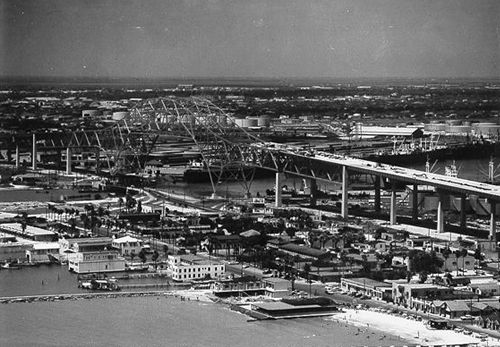
TX - Corpus Christi Harbor Bridge under construction
Corpus Christi Harbor Bridge, Texas Department of Transportation

"She is the manifestation of our collective will not only to survive, but to thrive as a nation of free people.  On behalf of the United States, thank you to all the men and women who have touched this fine ship, who have designed her, built her, took care of her and sailed in her."
-Commander Travis Petzoldt, Commanding Officer, USS City of Corpus Christi (SSN 705), decommissioning ceremony
    
    I left my motel room, drove further south on I-37, and took the exit to get to Ted's ranch. It was the summer of 2009.  I had just finished grad school in Toronto and flown to Dallas to spend a weekend with my best friend from college.  The following weekend, I would meet back up with him and the rest of my college friends for our unofficial five-year reunion at one of the guys’ family’s ranch, near the nowhere town of Frost.  There, we would drink and eat like morons for 48 hours before going back to our jobs in finance and law.  In between those two weekends, I visited other people in Texas.  This included Blue Feather, my older Navajo shaman friend who, with his wife, had adopted me as their grandson of sorts when I was stationed in Texas.  I had met Blue at the one alternative, hippie cafe--the sole demilitarized zone--in Corpus.  It was the same place actually where Ted had met his wife, Heather. 
At the end of this summer, I would head to Uganda for a year and a half with a volunteer-teaching program.  In Uganda, sure, I might have done a little good, and I did without some luxuries, but all in all, it was a fairly privileged jaunt.  In short, my post-navy life was adventurous and pretty carefree.  With some savings (from having been overpaid vis-a-vis the social value I provided as a naval officer) and with no major attachments, I moved where I wanted to and when.   
The no-man’s land between San Antonio and Corpus Christi had always struck me as ugly, when I was stationed down there.  Now, though still very desolate, it struck me as almost pretty.  And if not actually pretty, then gritty, with a sort of hidden beauty, in the way that non-gritty outsiders can pontificate about at least.  Maybe it was my allegory for Ted. 
The waning, late-afternoon Texas sun welcomed me into his driveway.  I hadn’t seen my good friend in three years, after he left the USS Pelican.  Some time after him, I too had bested Captain Ahab and the non-seagoing Pelican and got to leave Texas as well.  Then, we completed our respective next tours--mine in Japan, Ted’s in San Diego--and thus survived the surface navy, intact.  Oddly enough, this reunion was back in the Lone Star State, where we swore we would never return--me, “the gun-hatin’ liberal from the North” and Ted, “the wrong type of Mexican for Texas” (both Ahab-attributed epithets).  Yet, my facial and unkempt hair and light-hearted smile gave all indications of civilian life.  All was to be ok.  This was a triumphal reunion. 
            I timidly stayed near my rental car on the clay and asphalt driveway, away from the two angry mastiffs yelling at me.  I wasn’t sure I was at the right ranch, and I had read somewhere (a thousand times) that I shouldn’t mess with Texas.  Heather came out of the trailer home, calmed the dogs, and greeted me.  I didn’t know Heather too well, but it was good to see her.  She had represented the non-navy Corpus Christi world for me--and certainly for Ted--and for that alone, I held her in high regard.  We made small talk until Ted came home shortly thereafter.  The mastiffs barked more warmly for him.
He and I walked around the ranch with bottles of cheap beer in hand.  He had bought these thirty acres right after San Diego.  The trailer was temporary until they could build something less mobile, he told me, but he didn’t need to apologize for any frugality.  We caught up and recalled our non-war war stories from the Pelican.  Mike putting a cold .38 special in Ted’s stomach as they drove to a movie just to show off his new toy and mess with Ted, who was the driver by the way.  Ahab threatening to “step on Castro’s dick.”  Supply and Engineering Departments’ loyal patronage of the Russian call girls at Seashells in Bahrain.  The mutiny against Ahab--is it still technically a mutiny if the ship is tied to the pier?  Mike pressing the alarm button on the walkie-talkies every time XO Kim tried to say something.  Ted and I getting chased by the cops after the karaoke fight at the Chalet Lounge in Ingleside, now just ninety minutes south of this reunion. 
We imagined Ahab at the edge of the ranch that night, with one of his sic semper tyrannis, NRA-sponsored semi-automatic rifles, hiding in the bushes, looking to avenge his mutineers.  He had, off the record, promised to “get every single one of [us] motherfuckers back.”  Ted and I laughed triumphantly, as we recalled the Pelican.  We had lived through that ship and that shit. 
When I first met him in Bahrain in 2004, Ted was 30 going on 55.  He seemed to already have lived three lifetimes, and as a byproduct, he developed a beautiful gallows humor, of which both Vonnegut and Joseph Heller would be proud.  A humor that had been incubated, birthed, and sharpened by a lifetime of visits to the gallows, both before I ever him and during his tour on the Pelican.  He possessed the heartiest of laughs, so hearty that it rattled in his interlocutor’s ears and soul.  His laugh still reverberates with me.
Bakersfield, Ted's home, sits at the bottom of the San Joaquin Valley and is surrounded by a three-sided mountain range.  It was a country town when he was a kid, he described to me, with the economy being driven by oil and agriculture.  Ted’s mom’s father was, generations back, of Welsh descent.  He was an Okie, who left the Dust Bowl for California, along with Steinbeck’s Joads and the thousands of other families.  Ted’s mom, Linda, grew up in Bakersfield.  Ted’s father, Ted Senior, was from Bakersfield too, mostly Mexican but part Greek.
Ted Senior was stationed at Fort Bragg with the army. He was on duty one evening when Linda was raped in their trailer park.  They already had one boy, and Linda was eight months pregnant carrying Ted.  The family moved back to Bakersfield, and Ted was born prematurely due to the rape.  Ted Senior was discharged from the army due to “hardship,” and then he left Linda because he was embarrassed by the rape, by the hardship, as Ted tells it.  Linda and her two boys stayed with her parents for a short time until they were asked to leave.  Linda’s father, the Okie, hated the fact that the boys were mixed blood and the fact that his daughter had been raped by a man who happened to be black.  “The doctors thought I would die due to complications in birth, and I lost weight,” Ted told me.  They lived on the streets and later found shelter in Linda’s friend’s shed. “Well, I made it anyway,” he proclaimed and followed with his signature laugh.
By the time we met then, Ted’s life held wisdom and heartbreak that I couldn’t fully appreciate.  I was a snarky yet sheltered kid from Notre Dame and, before that, from white suburbia prep school-dom.  On the face of it, he probably should have hated me.  But, he took a liking to me.  Or, in such close quarters on our little minesweeper, he had no choice but to spend time with me.  He looked out for me.  He shielded me from senior officers on-ship and buy-me-drinky girls off-ship, and, as he was prior enlisted, he gave me advice about the sailors in my division.  I thought I knew music, but he introduced me to the Killers--their first album, Hot Fuss, had just been released--Tom Waits, Merle Haggard, and Okkervil River.  I thought I knew books, but he introduced me to Kazantzakis and re-introduced me to Steinbeck, both explicitly by book suggestions and implicitly by his own life, whose topography in the San Joaquin Valley was akin to Steinbeck’s characters’ in the neighboring Salinas Valley.  At least it seemed so, to an easterner who had been to neither.  I thought I might become a priest in my future, post-navy, still-prude-and-pious life, but he talked about women and love like he was one of Garcia-Marquez’s magical, holy fools-in-love.  That love might not have been the most realistic love.  It’s what got Florentino Ariza in trouble so often and maybe what would eventually trip up Ted, but it sounded lovely enough to rule out celibacy.  On every other person, I would have said that the orange-gold 1976 Cadillac would have been a waste of money in Texas--a bad, junior-enlisted-sailor-type financial decision--but Ted made it work and drove that boat like the goddamn naval officer he was.  He had joined the navy for “the romance of the sea” after all, as he told his recruiter.
After the Pelican, we didn’t stay in great touch, and I probably would not have considered him my closest friend.  But because of that uniquely Orwellian-Mel Brooksian experience together at Naval Station Ingleside, his friendship was one of the most special in my short life.  That’s why it was so good to see him and to hear his laugh at this Texas reunion in 2009.  Ted was flipping burgers at some fast-food joint, which was not the ideal job, but he had a couple leads for good steady work in the area.  He and Heather had land.  And they were on land.  That is, they were not out at sea, which experience had taught us was a good start.  They had dogs, and I saw the baby books in their home.  They were working on something. 
He made it, like he had done as a premature baby.  Together, we were triumphant: Andy Dufresne and Red on the beach at the end of Shawshank with the rest of our lives before us.  The hardest parts presumably behind us.  That evening, we embraced, I said goodbye to him and Heather, and I continued my tour around Texas.  I made it back up to Frost to play beer pong and drive ATVs, and eventually to Uganda and the rest of my life, which not without small hiccups, has been relatively carefree.  
Over the course of those eight years, Ted and I lost touch again, as things tend to go.  Three summers ago, I tried to look him up before I headed back down to Texas for another trip, but I had no luck.  But then just two Thanksgivings ago, he tracked me down.  We started with the navy references and jokes, and his laugh rattled once again, this time through the telephone.
“How the hell have you been?” he asked.  
We were picking up right where we left off at that Texas ranch in 2009.  I told him about him about the two things kicking my rear that fall, like I told all people I knew well enough: my new teaching job at the charter school and the abscess-fistula on my ass.  It seemed like a good war story, and I had gotten practice in telling it.
“And what about you?”  It was my turn to ask.
“Well, the short of it is: After I saw you last, I couldn’t find good work.  Heather was going to leave me if I didn’t.  So, I joined the army.  I wanted to be a combat medic, but it took me a long time for them to let me enlist, instead of go officer.  Then I had a long, unintended stay at artillery school.  Over the course of these years, I’ve deployed three times to Iraq.  The third time there, I came across an IED, and from what I remember or am told, the back of my Kevlar helmet hit the back of my heels. I had all types of injuries, especially back and spine, and I was laid up for months in army hospitals.  In one of those hospitals, I received orders to Afghanistan, but as I was confined to an army bed, I couldn’t go [laugh].  The young, gung-ho guy who went in my place got his legs blown off, by the way.  Still, I have all types of pain.  I was discharged from the army with 100% disability from the VA, and Heather was my VA-designated caretaker.  But in the meantime, she divorced me.  I think she was skimming off the top of those payments.  She has my two boys, only one I know is mine for sure.  I have a restraining order against me now because I beat up one of her boyfriends.  I didn’t want some dude half my age telling my son what to do [laugh].  Oh yeah, my mom died from the cancer that came back, from years ago.  Then, I was back with my dad before he kicked me out.  We got into an argument that was deep-seated, of course, but was set off by Fox News.  I was in touch with my brother, but now he’s out of the picture.  I’m 5’7”, 300 pounds.  It’s hard to sleep because of my back.  I drink too much. And, yesterday, I got this truck for $600 off Craigslist from some guy who was willing to sell it to a disabled vet.  Well, the wheel came off, and I woke up in a ditch with a cracked rib.  But other than that, I’m fine!”
And that hearty laugh as his exclamation point.  I laughed, too, and I might have cried.
“Holy shit...what the hell?...the army?...enlisted?...I thought we were done with the…..”
“Yeah...fuckin’ A.”  And then another raucous laugh.  

After that call, Ted and I were in touch here and there for six months, but I’ve since lost track of him again.  I’ve checked the Texas obituaries and police blotters to make sure he’s not dead or in jail.  I do hope our paths will cross again soon, in person and on land.  In the meantime, from my friend, I’ve garnered some life lessons, life lessons that fall somewhere between the personal and the political.
Like a Steinbeck story or a Springsteen ballad, or heck even one or two Old Testament stories, we learn that our lives are beholden by both our individual decisions and the stations we were born into.  Both the individual choices we sort of have control over and the larger structures we don’t.  For some, it’s hard to escape one or the other or both. 
Maybe the Cadillac wasn’t the best choice.  Less trivially, there were some warning signs with his relationship with Heather, pre-marriage.  Probably the army wasn’t the best option.  Or even the navy the first time, with its promised romance of the sea.  
These were the decisions and stations that broke his heart and broke his body.  And yet at the same time, he entered into each in good faith and with great love.